
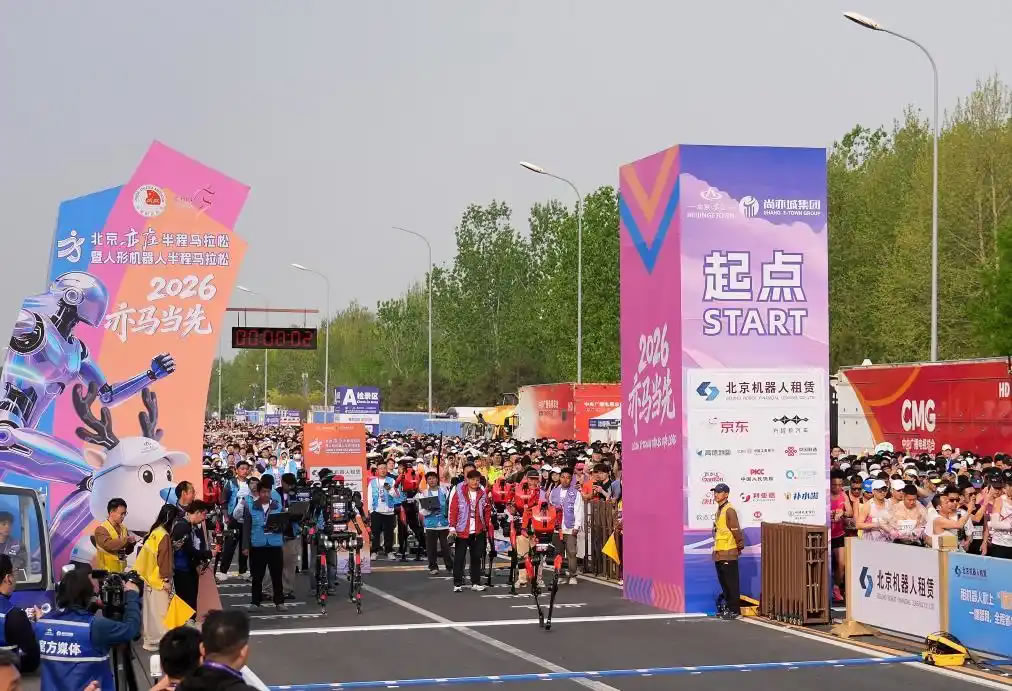
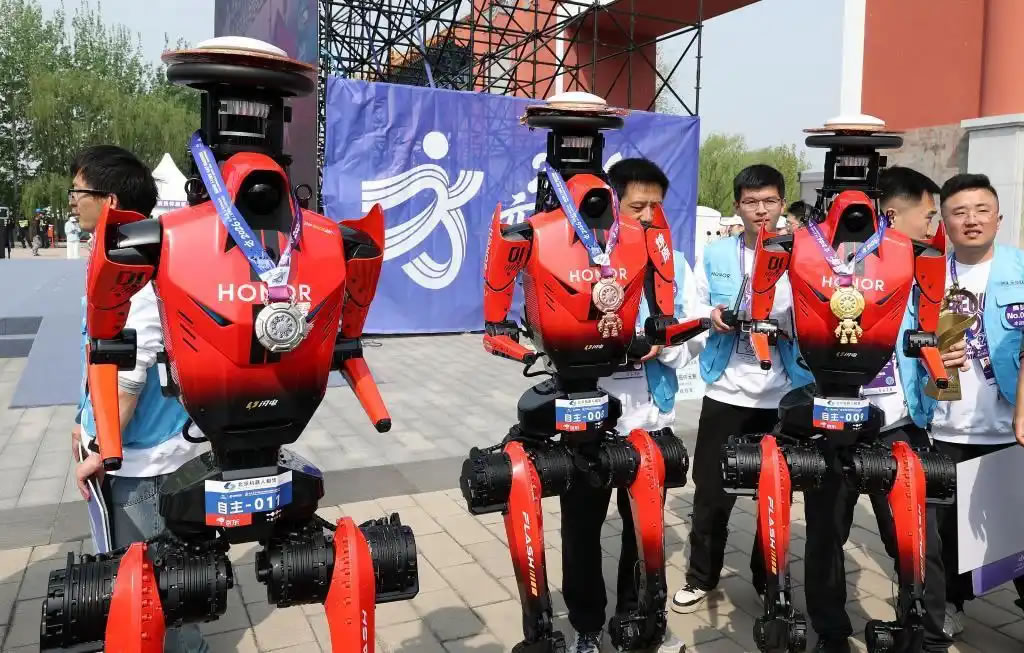
On April 19, 2026, at the 2026 Beijing E-Town Half Marathon & Humanoid Robot Half Marathon, the “Flash” robot, developed by Shenzhen Honor Smart Technology Development Co., Ltd. (the Qitian Dasheng Team), won the championship with a net time of 50 minutes and 26 seconds — nearly seven minutes faster than the 57 minutes and 20 seconds set by Ugandan star runner Jacob Kiplimo this past March. This achievement marks a new milestone in human-robot racing history. It is not only a special athletic competition but also an extreme test that drives industrial development. Global teams will accumulate valuable data here, accelerating breakthroughs in core technologies such as embodied intelligence and motion control. Meanwhile, the unprecedented scene of humans and robots starting together and sharing the same track will once again spark limitless imagination about the future.
The number of participating teams “exploded” — a fivefold increase — from 20 teams last year to over 100 this year. The participants include well-known domestic companies, universities and research institutes, independent developers, and five international teams making their debut, making the competition more diverse.
The course became more difficult. According to the organizers, this year’s course integrated more than ten terrain types, including flat sections, slopes, curves, and narrow passages, with a maximum 8% uphill grade, 6% downhill grade, and a cumulative elevation gain of 100 meters — testing the robots’ power control and energy management efficiency. A curb obstacle was even added to simulate unexpected situations on urban roads, placing higher demands on the robots’ core capabilities.
The winning robot’s finishing time of 50 minutes and 26 seconds has already surpassed the best level of elite human athletes — a dramatic improvement from last year’s robot champion time of 2 hours, 40 minutes, and 42 seconds. More Preparation: Many robots were equipped with higher-power motors, robust cooling designs, and reliable self-developed limb joints. Extensive efforts were made on running posture and aerodynamic drag reduction. The peak torque of many robots was significantly increased, designed specifically for marathon running.
In Beijing E-Town, more than 300 humanoid robot enterprises have formed a complete industrial chain covering core components, complete machines, and application scenarios, providing solid support for the deep integration of technological innovation and scenario applications. In Shenzhen’s Nanshan District, there is a full-chain layout from R&D to industrialization. Enterprises and research institutions are closely linked — “upstairs and downstairs can cooperate”. Nearly half of the components can be sourced within 10 kilometers, greatly improving industrial coordination efficiency and accelerating commercialization.
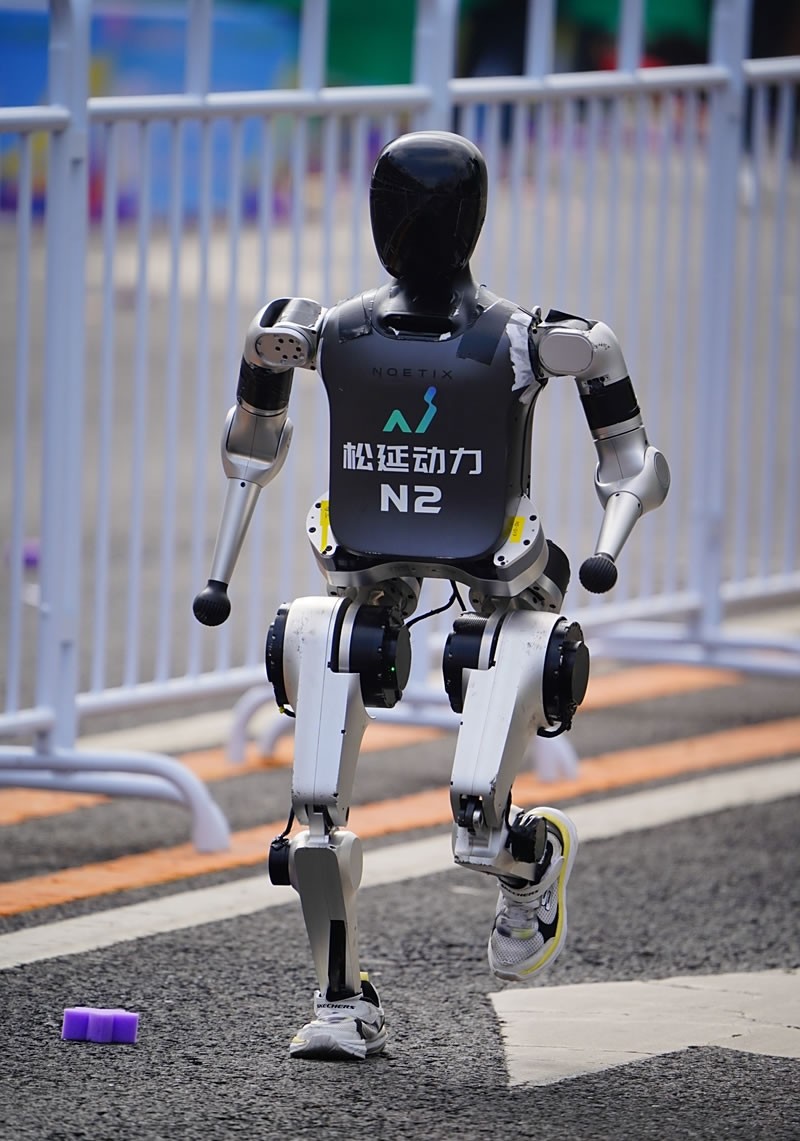
For robots, a half-marathon is essentially a set of engineering metrics: continuous power output, structural durability, thermal management capability, energy efficiency, and autonomous navigation. On the hardware side, reinforcement learning allows robots to run in a more optimized way. The large-scale application of autonomous navigation technology has enabled robots to leap from being “controlled” to “running on their own”. Nearly 40% of this year’s teams adopted autonomous navigation, with robots relying entirely on vision cameras, LiDAR, and multi-sensor fusion systems for real-time environmental perception, path planning, and dynamic obstacle avoidance. This means robots no longer need a human following behind with a remote control — they are truly seeing the road with their own “eyes” and making decisions with their own “brains”.
