
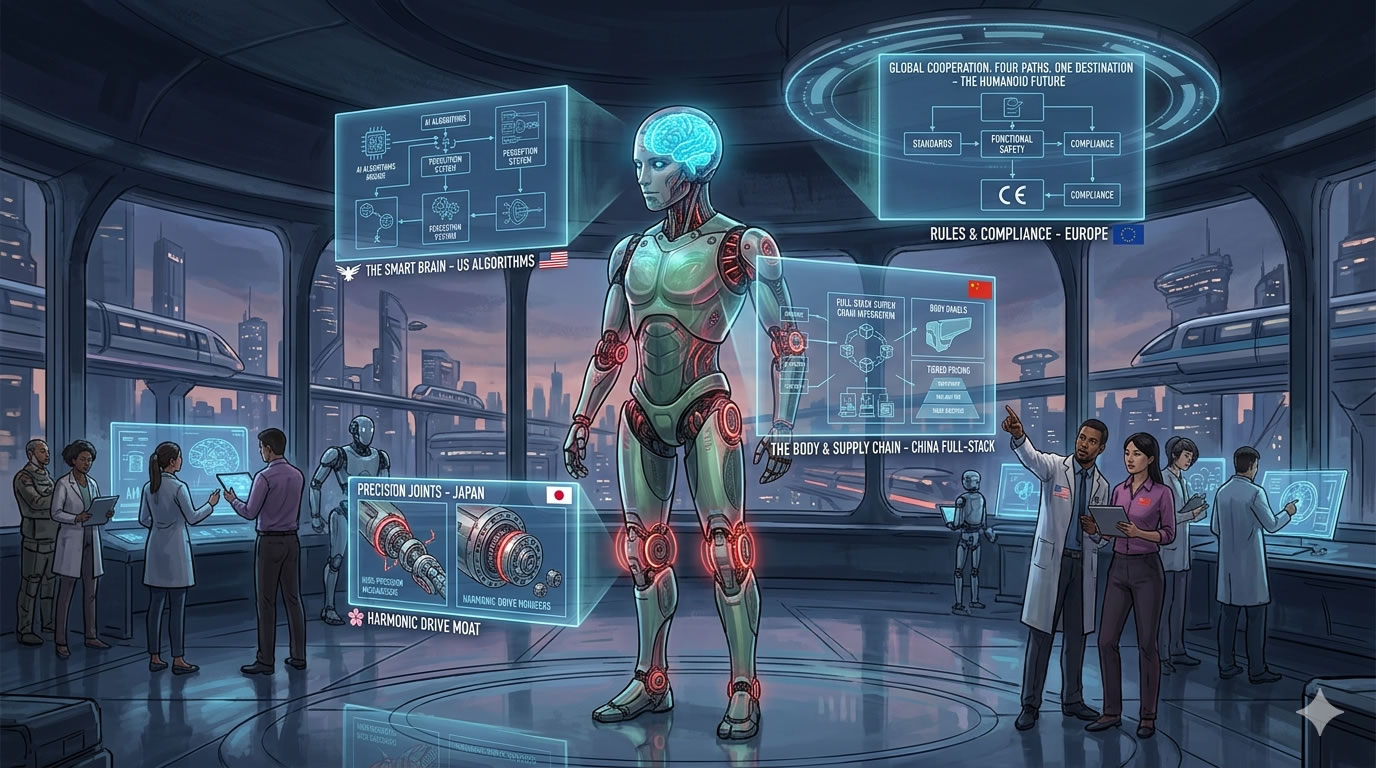
Global Competitive Landscape: Four Paths, Four Logics
From 2026 onward, the global race in humanoid robots is no longer a single‑dimension sprint of “who runs faster or jumps higher.” Instead, it is a simultaneous game of four distinct technological routes and industrial logics. Different countries have chosen different breakthrough paths based on their endowments: Japan solidifies its technological moat in precision components, the United States shifts from “showmanship” to “real‑world deployment,” China seizes the market with diverse scenarios and tiered pricing, and Europe seeks influence through standards and compliance.
According to the latest research from TrendForce, China, Japan, the US, South Korea, and Germany have long ranked among the top five in industrial robot installations, but in the field of humanoid robots they have already diverged into different strategic centers.
Dimension 1: Supply Chain – China’s “Full‑Stack Closure” vs. the US’s “Hardware Bottleneck” vs. Japan’s “Precision Stronghold”
At the supply‑chain level, a “war without gunpowder” is unfolding in humanoid robots. China’s advantage lies in “completeness” – from sensors and motors to actuators, China has built the world’s most complete industrial chain of robot components. A manufacturing network that can deliver “3‑day prototyping and 7‑day mass production” enables China to jump from a lab prototype to shipments in the millions within months.
🟢 China: The extreme of a full‑stack supply chain
- Completeness: China has already built a full industrial chain covering core parts (sensors, motors, reducers, etc.) as well as body manufacturing and system integration, creating a strong agglomeration effect.
- Localization depth: AgiBot has stated that almost all core components for its humanoid robots can be sourced within a two‑hour driving radius from Shanghai.
- Complete industrial ecosystem: China possesses the world’s most complete set of 41 industrial categories, 207 medium categories, and 666 sub‑categories. This unique global industrial supporting system provides unparalleled infrastructure for the rapid iteration and mass production of humanoid robots.
🔵 The United States: Algorithmic advantage vs. supply chain gaps
- AI software strength: The US boasts the world’s strongest AI ecosystem and algorithmic capabilities, leading in areas such as perception, reasoning and decision‑making, motion balance control, physical space understanding, and interaction. The US has formed a pattern of “algorithm hegemony and system integration.”
- Hardware supply chain vulnerability: However, the hollowing‑out of US manufacturing makes it heavily dependent on global supply chains. Core components such as actuators for humanoid robots rely heavily on Chinese supply. According to Morgan Stanley’s calculations, if Chinese parts were completely excluded from the Optimus Gen 2 supply chain, its cost would skyrocket from $46,000 to $131,000 – nearly tripling.
- “Body” constrained by China: Some analysts have asserted that the US cannot reasonably mass‑produce the materials needed for humanoid robots at acceptable cost, and that China holds key influence over the hardware supply chain of US robotics. Once China “hits the off switch,” the entire American robotics build‑out would slow down.
- High‑profile case in point: Disney’s “Olaf” robot, shown by Nvidia CEO Jensen Huang in March 2026, used core parts for its limbs supplied by China’s Unitree Robotics. This detail reveals the deepest technological reality: even with the most advanced AI chip computing power, the “body” of a humanoid robot still cannot do without Chinese manufacturing.
🔴 Japan: The technological moat of precision components
- Holding the choke point: Japan possesses world‑class technological heritage in precision core components like high‑precision reducers – Harmonic Drive holds more than 80% of the global harmonic‑drive market.
- Technology gap: The advantage of Japanese firms like Harmonic Drive lies in gear‑tooth design, flexspline materials, and production processes, producing smaller, lighter, longer‑lived products with an extremely high moat in the high‑end market.
- Pinpoint positioning: Japan has deep roots in industrial robots. More than 80% of the global precision reducer market is monopolized by Japanese companies. Its role is more like a “gatekeeper” – it locks the supply‑chain lifelines of all players at that critical juncture.
Dimension 2: Cost – China’s “Price‑Floor Break” vs. the US’s “High‑End Barrier”
The cost gap in humanoid robots is the most direct numerical evidence of global manufacturing capability.
🟢 China’s cost advantage:
This is not simply cheap labor; it is a systemic benefit from full‑industrial‑chain collaborative cost reduction.
- Core component costs: Domestically made core components such as sensors and servo motors cost on average 30‑40% less than their European and American equivalents, and a dexterous hand costs only about one‑tenth as much as its Western counterpart.
- Overwhelming price advantage: Unitree’s entry‑level G1 is priced around $6,000, just about $14,000 after tax; AgiBot’s robot is also around $14,000. In contrast, Boston Dynamics’ Atlas is priced at over $3 million per unit, mainly for military and research scenarios, presenting a completely different cost curve.
- Striking comparison: Sometimes a Chinese robot costs less than a top‑of‑the‑line Apple smartphone. This “consumer‑product benchmarking” pricing logic forces the global market to rethink the speed of robot commercialization.
🔵 The US price dilemma:
Tesla’s cost target for mass‑producing Optimus vividly illustrates America’s price pressure – it must drop from about $43,000 at small‑batch stage to under $20,000 at mass production, a goal that relies heavily on the collaborative efficiency of China’s supply chain.
🔴 Japan’s price disconnect:
Japan’s share of the global humanoid robot market – about $3‑3.3 billion in 2025 – is only about 15‑20%, and its shipment share is around 10%. High‑quality components produce high‑end robots, but they limit competitiveness in the affordable market.
Dimension 3: Corporate/Foreign Attitudes – From “In China for China” to “In China for the World”
🟢 The global rise of Chinese enterprises:
Chinese companies are exporting solutions globally with full‑chain capabilities.
- Overwhelming global market share: Global humanoid robot shipments in 2025 stood at around 13,000‑18,000 units, of which Chinese enterprises accounted for roughly 81% to 90%. AgiBot shipped over 5,100 units, ranking first globally with a share of about 39%.
- Industrial pyramid and patent accumulation: The number of Chinese robot body makers has exceeded 140, forming a pyramid‑like industry structure. According to Morgan Stanley, China registered 7,705 humanoid‑robot‑related patents in the past five years – more than six times that of the US (1,225) and far above Japan’s 1,102.
- Capital and scale: Chinese robotics companies are already far ahead in financing and deployment speed. In 2025, Chinese factories installed 295,000 robots, roughly ten times the number installed in the US.
🔵 Foreign capital “doubling down on China” – a trust vote in the supply chain:
- ABB’s “closed loop in China”: ABB Group plans to strengthen its presence in China. More than 90% of the robots it makes for Chinese customers are already produced locally, and local Chinese suppliers will account for about 80% of its procurement, forming a closed‑loop domestic supply chain.
- UBTECH’s $1 billion strategic investment: Infini Capital (from Hong Kong and Abu Dhabi) has provided UBTECH with a strategic financing facility of up to $1 billion; the two parties also plan to jointly invest in the humanoid robot supply chain.
- The challenge of “de‑risking”: In early 2026, citing supply‑chain dependency concerns, the US added Chinese companies like Unitree to its entity list, attempting to “clear US capital, cut off financing, constrain the supply chain, and seal the market.” Yet the great difficulties of a hard decoupling precisely prove the irreplaceable strategic value of China’s supply chain in the global robotics industry.
- Localization 2.0: Multinationals are accelerating their shift from “in China for China” to “in China for the world,” and products developed in China are now being supplied back to global markets.
Dimension 4: Global Division of Labor – “Brain” vs. “Body” vs. “Joints” vs. “Rules”
Drawing on the International Federation of Robotics (IFR) white paper published in August 2025 and analyses from several market research firms, the global humanoid robot landscape can be precisely divided into four forces, each with its own offensive and defensive strategies:
| Economy | Core Strength | Strategic Role | Representative Players |
|---|---|---|---|
| 🟢 China | Full‑chain mass production, cost control, diverse scenarios | “Body that supplies blood” | Unitree, AgiBot, UBTECH |
| 🔵 US | AI software, algorithm ecosystem, high‑end chips | “Smart brain” | Tesla, Figure AI, Boston Dynamics, Nvidia |
| 🔴 Japan | Precision reducers, new materials, industrial robotics | “Precision joints” | Harmonic Drive, Honda, Fanuc |
| 🇪🇺 Europe | Functional safety certification, industrial equipment, rule‑making | “Compliance cornerstone” | ABB (Switzerland), KUKA (Germany) |
The layered logic of the four‑way division:
- The United States plays the “chief architect” – controlling the AI computing power and algorithm ecosystem. In 2024, US private AI investment reached $109.1 billion, compared to only $9.3 billion in China.
- Japan acts as the “gatekeeper” – locking the global supply chain lifeline at the critical reducer node. In 2025, Japanese manufacturers still held more than 50% of the high‑end harmonic‑drive market.
- China plays the “body that supplies blood,” ensuring that core components are independently controllable and achieving mass production at unbeatable cost‑performance. TrendForce notes that China penetrates the market through “low‑cost mass production” and “diverse scenarios.”
- Europe plays the “rule‑maker” – setting the entry thresholds for global markets through standards and compliance. Europe has world‑leading legislative and certification capabilities in areas such as functional safety (CE), data privacy (GDPR), etc., providing a regulatory template for global humanoid robot exports.
As some industry observers have summarized the essence of this humanoid race: “America provides the brain, China forges the body, Japan polishes the joints, and Europe makes the rules.” The four are not in a simple competitive relationship but are embedded in a complex network of co‑opetition.
Conclusion: A “Third Path” Defined by China
Amid the interweaving and restructuring of these four forces, China has forged a distinctive “third path” –
This is not a low‑price dumping strategy; it is the systemic competitiveness of a full industrial chain ecosystem.
This path rests on three clear pillars:
- Extreme supply‑chain completeness – From cost advantage to coverage of the entire industrial ecosystem, China not only secures its own supply but also forces global robot giants to rely on Chinese core components.
- Deepening cost moat – The fact that core parts like servo motors are priced at only 60‑70% of their European/American equivalents, and a dexterous hand at just one‑tenth, sends a powerful signal to the global market: the timeline for humanoid robots to move from “lab luxury” to “industrial commodity” is set by China.
- First‑mover advantage of “scale‑driven innovation” – When Chinese enterprises already shipped nearly nine out of ten humanoid robots globally in 2025, what they gained was not just a production number, but real‑world scenario data and iteration speeds far beyond those of any competitor. This is an “industrial moat” that no single technological breakthrough can replace.
As TrendForce analyst P.K. Tseng pointed out: “The US leads in technological innovation, but China excels in execution speed. The real inflection point will occur when humanoid robots move out of research prototypes and into large‑scale deployment.”
