
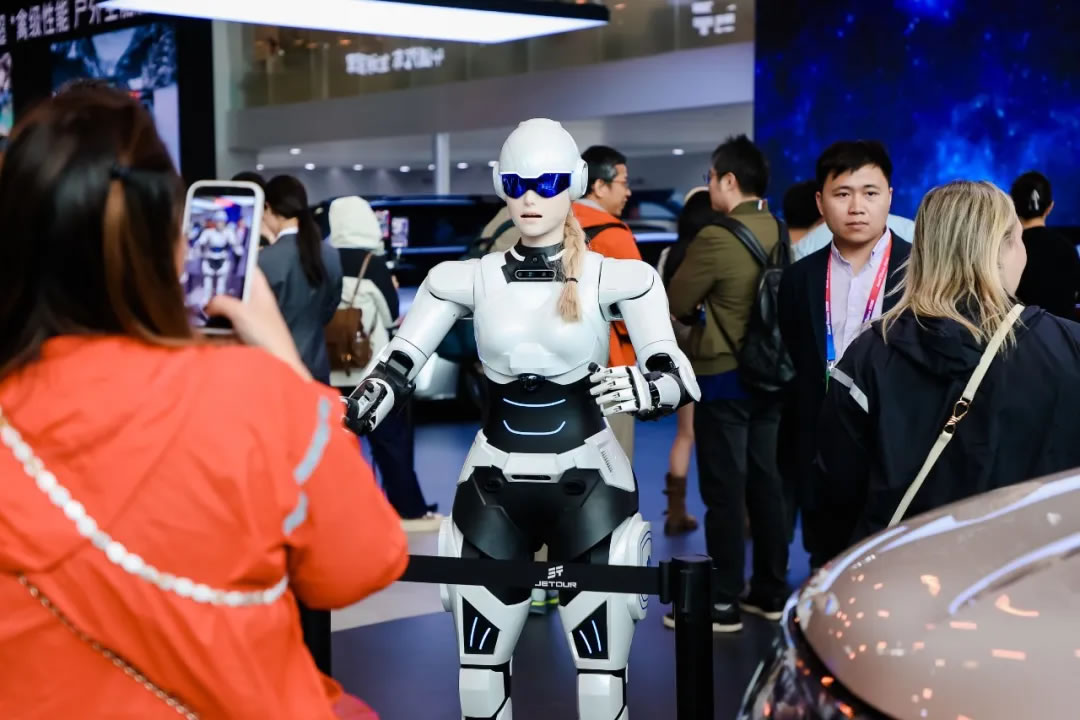
Beijing, April 24 – As Auto China 2026 opened its doors on Thursday, Chery’s robotics unit AiMOGA drew a steady stream of visitors with a lineup that included its intelligent policing robot, the humanoid robot MORNINE, and the quadruped robot Argos. The common thread running through the display wasn’t just the hardware — it was the idea that robots and cars should share more than a parking lot. They should share core technologies, too.
The Chery booth attracted more than 4,000 international guests on the first day alone. Around 2,500 of them have already made plans to travel to Wuhu, where Chery is headquartered, for deeper talks on how smart vehicles and robotics can grow together.
From automotive DNA to robot scale
AiMOGA’s speed in getting products to market owes a lot to Chery’s 20-plus years of vehicle R&D and manufacturing. The robotics team can pull from the same engineering pipeline, supply chain, and validation processes that Chery uses for cars, which means a concept can become a working prototype faster and production scaling doesn’t have to start from zero. The company is leveraging Chery’s global sales and service network to open a path into overseas markets, gradually moving toward what it calls global R&D, global manufacturing, global delivery.
On the research side, AiMOGA now runs 31 innovation labs across six key areas, covering embodied intelligence, perception algorithms, motion control, and human-robot interaction.
Real-world deployments already in place
Something that resonated at the show was how much of the technology has already left the trade-show floor. The intelligent policing robot on display is at work in multiple Chinese cities, handling student safety patrols near schools, traffic guidance, and event security. AiMOGA says it is in talks with more than 50 cities interested in deploying the system. The robot combines multi-sensor fusion navigation with a traffic management large model, allowing it to patrol on its own, flag traffic violations, and coordinate signals — helping to ease the workload on front-line officers.
Argos, the quadruped robot dog, has also moved beyond the demo stage. It passed 1,000 cumulative deliveries last year and is being used in settings ranging from home companionship and exhibition performances to neighborhood security. “It’s one thing to watch a robot dog do a backflip in a video, but the real test is whether it works reliably day after day in a real-world setting,” an AiMOGA engineer at the booth said. “We think Argos has cleared that bar.”
Autonomous driving tech finds a second life
Under the hood, a broader technology migration is underway. AiMOGA is adapting perception systems from Chery’s autonomous driving work for its robots, giving them centimeter-level positioning, dynamic obstacle avoidance, and full 3D awareness in complex environments. The robots also draw on the automaker’s battery expertise and are equipped with Chery’s solid-state batteries to handle long-duration tasks without frequent recharging.
NVIDIA partnership targets physical AI
A strategic partnership announced on April 23 between Chery and NVIDIA gives the effort another push. The two companies plan to work together on physical AI across driver assistance, in-cabin AI, and robotics. For AiMOGA, a wholly owned Chery subsidiary, that means developing humanoid and multi-purpose robot platforms built on NVIDIA Jetson, while tapping NVIDIA Isaac Sim and the NVIDIA Isaac GR00T platform to create a pipeline from simulated training to real-world deployment.
“We’re not a science project”
When asked about the road ahead, a company spokesperson said: “We want these robots to serve actual needs in actual places. The technology follows the product, and the product follows the scene.”
What AiMOGA showed in Beijing feels less like a futuristic concept and more like a progress report on a strategy that started in the automotive world and is steadily extending into everyday environments.
