
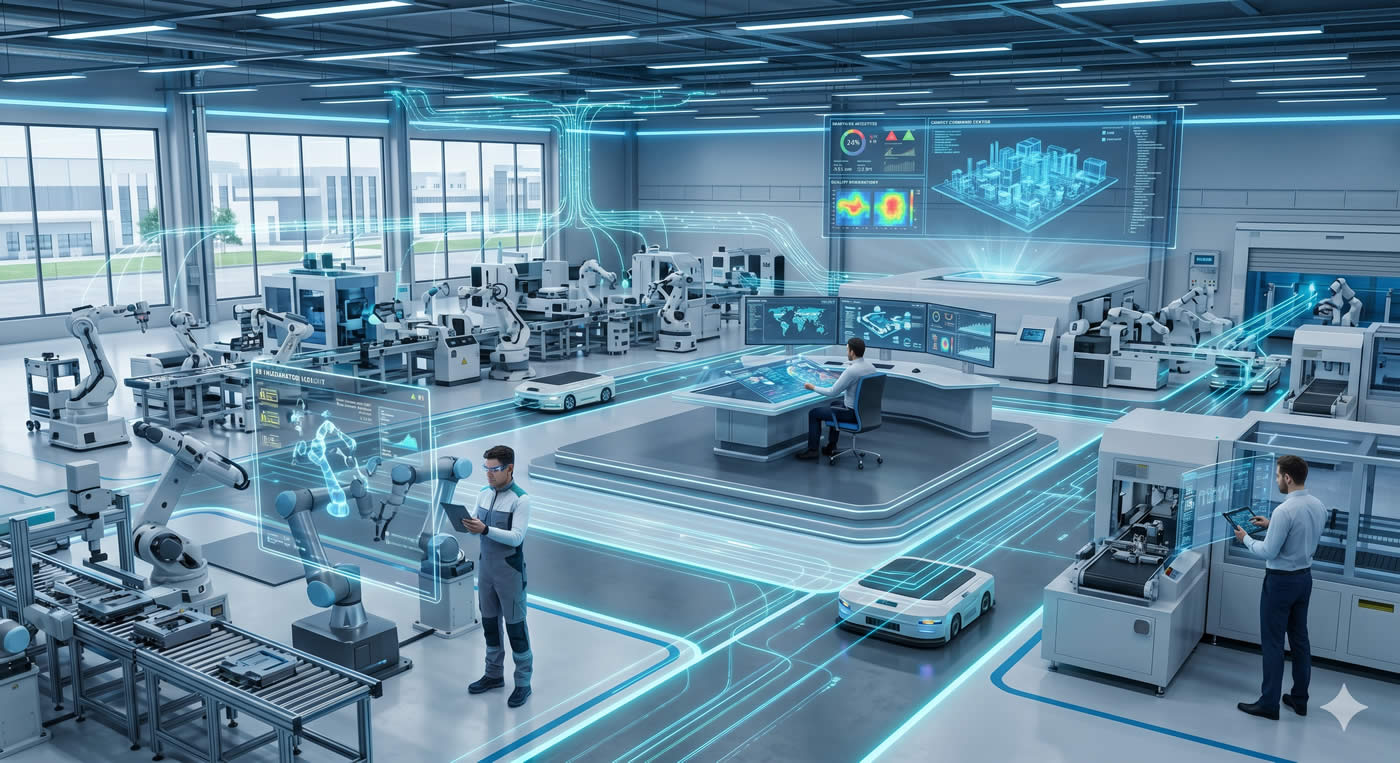
By 2026, three things separate smart factories from the rest: machines, systems and processes that talk to each other through the Industrial Internet of Things (IIoT); data that works as hard as any physical asset, refined by advanced analytics and AI; and production lines that increasingly run themselves. This isn’t a distant vision. It’s already taking shape on factory floors from Germany to Guangdong.
What “smart” actually means now
The shift from digitalization to intelligence isn’t just a buzzword upgrade. At its core, it’s about manufacturers wiring up their operations with sensors and connected devices, pulling in streams of real-time and historical data, and feeding that data into models that handle predictive maintenance, quality control and production scheduling. The old way—relying on experience and figuring out what went wrong after the fact—is giving way to something more precise. When a machine can tell you it’s about to fail before it does, downtime stops being a surprise.
The results show up in straightforward business metrics: less idle equipment, higher throughput, fewer scrapped parts, lower energy bills. The underlying shift is from automated execution to autonomous decision-making, where systems adapt without waiting for a human to approve every adjustment.
Why it’s happening now
No single technology is driving this. It’s a collision of pressures and enablers.
Cost pressure and efficiency
Cost is the obvious one. Labor isn’t getting cheaper anywhere, energy prices swing unpredictably, and raw materials keep climbing. Manufacturers are turning to AI-driven process optimization, real-time monitoring and digital twins to find slack they didn’t know existed. Take Siemens’ Amberg plant in Germany: by running a digital twin of its entire production line, the facility now achieves a 99.9988% quality rate while handling over 1,200 product variations on the same lines—something impossible with conventional scheduling.
Supply chain restructuring
Supply chains are the second pressure. The assumption that parts will always arrive on time from halfway around the world has collapsed. Companies are regionalizing production, bringing it closer to customers. That adds cost—which is precisely why those new facilities are being designed from day one with higher levels of automation, collaborative robots and digital control systems. The math only works if the factory runs leaner than its offshore predecessor.
Labor shortages
Then there’s the people problem. Skilled workers are retiring, and replacements aren’t lining up. In response, manufacturers are deploying collaborative robots on assembly lines, computer-vision systems that inspect parts faster and more consistently than human eyes, and remote-support tools that let a specialist in Stuttgart troubleshoot a machine in Suzhou without boarding a plane.
Infrastructure maturity
On the infrastructure side, the pieces are finally in place: IIoT standards are converging, edge computing handles processing right on the factory floor, and cloud platforms tie it all together. The long-promised convergence of operational technology (OT) and information technology (IT) is actually happening, creating data loops that connect design, production, procurement and after-sales service.
AI as a core production tool
AI, meanwhile, has moved from a cost center to a core production tool. Manufacturers are applying it to maintenance scheduling, quality inspection and demand forecasting with measurable returns. BMW’s Spartanburg plant in the US, for instance, uses AI-driven quality control systems that analyze over 1,000 images per second on the production line, catching defects that human inspectors previously had to spot manually. The payoff isn’t just accuracy—it’s freeing skilled workers for higher-value tasks.
Where the technology is heading
Three developments deserve attention.
AI and edge computing merging
First, AI and edge computing are merging. When a robot arm needs to make a split-second adjustment, it can’t wait for data to travel to a cloud server and back. Edge processing puts analytics and decision-making directly on the factory floor. Tesla’s gigafactories rely heavily on this approach: vision systems on the production line inspect welds and component placement on every vehicle in real time, making micro-adjustments without pausing the line.
Digital twins at scale
Second, digital twins are moving from isolated use cases to enterprise-wide tools. A digital twin used to mean a simulation of a single machine. Now it’s the entire production system, connected to live data and capable of running “what-if” scenarios. When combined with AI, a digital twin doesn’t just mirror current operations—it predicts how the system will behave next week under a different product mix or supply disruption.
Open platforms and ecosystems
Third, the industry is shifting from closed proprietary systems to open platforms. The value is increasingly in interoperability—getting machines from different vendors, software from different providers, and data from different sources to work as one system. Technology vendors are building platforms that combine hardware, software and services, enabling collaboration across company and regional boundaries. What this means in practice is flexibility: a factory that can reconfigure itself when demand shifts.
What separates leaders from laggards
Smart manufacturing is moving from being a competitive advantage to a baseline requirement. The companies that come out ahead will share a few traits: they know how to pull together data from multiple sources and actually use it; they make operational decisions in real time based on AI recommendations rather than weekly reports; their production systems can absorb supply chain shocks without grinding to a halt; and they’ve figured out how to combine automation with human expertise rather than treating them as an either-or choice.
Firms that delay this transition won’t necessarily fail overnight. But they will find themselves with higher per-unit costs, slower response times and less ability to handle the next disruption—whatever form it takes.
The direction is clear. Manufacturing in 2026 and beyond will be defined not by how much a factory can produce, but by how intelligently it can operate. AI, IIoT and automation are converging to reshape not just production processes, but the logic of competition itself. Efficiency and resilience won’t be trade-offs. They’ll be two sides of the same coin—and that coin is data.
