
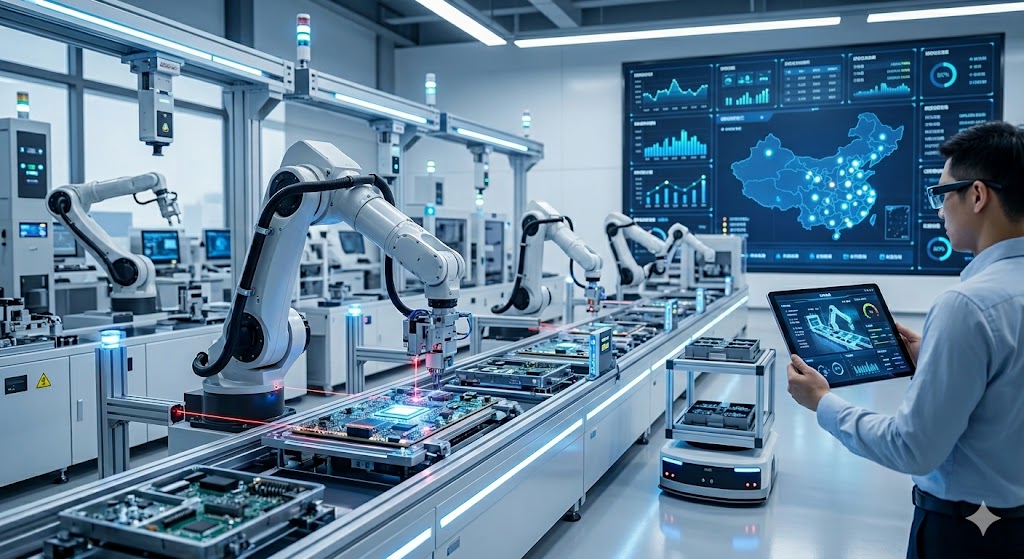
I. Core Components: From “Dependent on Others” to “Independently Controllable”
To understand the real strength of China’s robotics industry, the answer isn’t inside the robot’s shell — it’s in the invisible “joints” and “muscles.”
The three core components — reducers, servo systems, and controllers — account for more than 70% of a robot’s total cost. For a long time they were the deepest “cardiovascular wound” of China’s robotics industry. Reducers were nearly 90% monopolized by Japan’s Nabtesco and Harmonic Drive; servo systems were dominated by Yaskawa and Mitsubishi; and the core technology of controllers was also in foreign hands. A “made in China” robot still imported almost all its key parts from Japan.
In 2026, that story is being rewritten.
RV reducers — critical for heavy‑load joints like a robot’s waist and knees — were monopolized by Nabtesco for half a century. Today, domestic players such as Qinchuan Machine Tool and Nantong Zhenkang have stabilized their precision within 1 arc‑minute, achieved a service life of over 6,000 hours, and priced their products at only 40‑50% of imported ones. In 2026, the market share of domestic RV reducers exceeded 55%, achieving full substitution in light‑load applications (below 20kg). Shuanghuan Transmission’s RV reducers, supplied indirectly to Tesla via Tuopu Group, have also taken a substantial step toward localization.
The harmonic reducer sector is also turning a corner. Leaderdrive’s self‑developed “P‑tooth” design has pulled Harmonic Drive’s market share down from more than 80% to less than 40%. In 2026, domestic harmonic reducers surpassed foreign ones for the first time, capturing over 60% of the market. Leaderdrive’s annual capacity has exceeded 500,000 units, and it has become one of the main harmonic reducer suppliers for Tesla’s Optimus. The mass production of humanoid robots will drive rigid demand for 4‑6 harmonic reducers per unit, and the market size is expected to exceed $34.2 billion (250 billion yuan) by 2030.
The localization of servo systems and controllers is also accelerating. Inovance Technology is the absolute leader in China’s servo market, with a share of over 40%. Its SV660 series achieves positioning accuracy of 0.01mm and a response frequency of 3.5kHz, closing in on the technical specs of Japanese rivals. Mingzhi Electric has become a top‑three global player in coreless cup motors — a core component of humanoid robot dexterous hands — with efficiency close to Switzerland’s Maxon, but at just one‑third the cost of Japanese products. In controllers, Estun and SIASUN have mastered proprietary core technologies, with repeat positioning accuracy of ±0.02mm, approaching advanced international levels. The domestic substitution rate for controllers has already exceeded 60%.
These comprehensive breakthroughs in components have laid the foundation for a rise in complete robots. In 2025, China’s installed base of industrial robots exceeded 2 million units, making it the world’s largest application market. The overall domestic substitution rate for complete robots exceeded 55% for the first time, surpassing foreign brands. Domestic industrial robot brands reached a record high of 55% market share — within that, Estun topped the list with 10%, and Inovance also hit 10%, overtaking Fanuc to take third place. Collaborative robots (domestic players hold over 90% of the local market) and SCARA robots (Inovance is the solid No.1 with 27%) grew 29% and 23% year‑on‑year respectively, becoming the fastest‑growing sub‑segments.
The growth in industrial robot production is even more striking: in 2025, China produced 773,000 sets of industrial robots (above designated scale), up 28.0% year‑on‑year, with growth accelerating by 13.8 percentage points from the previous year. Production continued to accelerate in the first two months of 2026, and industrial robots are moving from “selective use” to “standard equipment.”
II. Humanoid Robots: China’s “Lane‑Changing” Overtake
If the success of industrial robots represents China’s “frontal assault” in catching up, its lead in humanoid robots is more like a “lane‑changing” overtake.
“By 2026, the hardware technology of the humanoid body has actually converged — there are no more difficult points,” said Kang Yu, general manager of the capital markets department at Shoucheng Holdings, after analyzing the half‑marathon. “The focus going forward is on how to combine the ‘large and small brains’ and how to build an ecosystem for motion control algorithms.” That echoes what AgiBot’s chairman Deng Taihua has said — he defines 2026 as the first year of the “deployment state” for embodied AI, when the industry shifts completely from “demonstration” to real productivity that is “deployable, deliverable, and profitable.”
Market data show that China already has an overwhelming share of global humanoid robot shipments. According to CounterPoint Research, about 16,000 humanoid robots were installed worldwide in 2025, and the Chinese market accounted for more than 80% of that. Four of the top five equipment manufacturers in global shipments were Chinese — AgiBot led with 31%, followed by Unitree with 27%. Omdia’s data confirms the picture: in 2025 AgiBot shipped over 5,100 units to rank first globally, Unitree followed, and together Chinese companies accounted for nearly 80% of the world total. As TrendForce analyst P.K. Tseng put it: “The U.S. leads in technological innovation, but China excels in execution speed.”
The root of this leadership is China’s extreme supply‑chain advantage. AgiBot has noted that almost all core components for its humanoid robots can be sourced within a two‑hour drive from a single city. Morgan Stanley’s calculations also show that if Chinese components were completely excluded from Tesla’s Optimus supply chain, its unit cost would soar from $46,000 to $131,000 — the existence of China’s supply chain is itself a structural variable that the global humanoid robot industry cannot avoid.
The mass‑production race has fully begun. On March 30, AgiBot’s 10,000th general‑purpose embodied robot, the “Expedition A3,” rolled off the line — just over three months after the 5,000th unit. Wang Chuang, AgiBot partner and senior vice president, further predicted that by 2027 AgiBot’s annual output could reach 100,000 units. UBTECH’s 1,000th Walker S2 came off the line at the end of 2025, and its 2026 production target is 10,000 units. Unitree, with a track record of more than 5,000 stable deliveries and five consecutive years of profit, has already started the IPO process on the STAR Market and is seen as a bellwether for the commercialization and capital markets prospects of the domestic humanoid robot sector. On March 30, the first domestic humanoid robot production line with an annual capacity of 10,000 units — jointly built by Leju Robots and Dongfang Precision — was put into operation in Foshan, Guangdong. The highly flexible assembly line completes 24 assembly steps, and each robot must pass 77 inspections and 41 automated tests before leaving the factory. Equipment is directly connected to the line without manual transport, ensuring consistent quality across all units. Ke Zhendong, executive vice president of Leju Robots, said: “The digital coordination behind ‘one robot every 30 minutes’ is not just a number — it’s the bridge that takes humanoid robots from prototypes to the market.”
Policy is also accelerating. Effective May 1, China’s first local regulation on embodied intelligent robots came into force in Hangzhou. It establishes mechanisms for tackling core technologies, opening up public data and computing resources, and encouraging government scenarios to give priority procurement and “first‑try, first‑use” to embodied AI. Hangzhou’s embodied AI industrial cluster has already achieved an output value of $14.6 billion (106.8 billion yuan), and it accounts for more than 80% of the national market for quadruped robots and over 50% for humanoid robots.
III. Service and Specialized Robots: From “Deep‑Sea & High‑Risk” to “Daily Companions”
If industrial robots are “replacing workers,” then service robots and specialized robots are “replacing the jobs that humans dare not do, are unwilling to do, or cannot do well.”
Specialized robots, which are directly linked to national strategic security, have become the segment with the strongest inelastic demand in China’s robotics industry. Recently, the country’s first embodied intelligent specialized robot was put into high‑risk applications. The robot integrates humanoid dual arms, magnetic‑suction wall‑climbing capability, and large‑model intelligence. Its upper body has 15‑degree‑of‑freedom humanoid arms, and its lower body is a wheeled plus magnetic‑suction chassis. It can autonomously perform welding, flaw detection, rust removal, and other high‑risk tasks in chemical storage tanks, ships, energy facilities, and similar environments. By simply swapping the end‑effector, it can instantly switch between inspection, painting, welding, testing, and other functions — all in one machine, delivering stable and reliable construction quality and dramatically shortening project timelines.
“This is the first time China has applied embodied intelligence to specialized industrial robots,” Pu Xiao, head of R&D for the embodied specialized robot, told CCTV reporters. “To train the large model, our robots have accumulated more than 100,000 hours of operation, traveled a total distance of 22,500 kilometers (more than half the Earth’s circumference), and covered an area of over 5,000 square kilometers — equivalent to two and a half times the area of Shenzhen.” This accumulation of massive, high‑dimensional data is transforming these robots from mechanical executors into truly intelligent workers.
Also now in use is China’s first self‑developed submarine cable inspection robot. This underwater intelligent device integrates sonar, electromagnetic detection, and mechanical manipulation. It can autonomously inspect submarine cables in water up to 300 meters deep and work in tandem with unmanned surface vessels, achieving ten times the efficiency of traditional manual methods. It provides a completely new technological foundation for the security of marine energy and communication networks.
In the service robot sector, the market is exploding. In 2025, China produced 18.581 million sets of service robots, double the 9.214 million sets produced in 2021. From home companionship and hotel reception to food delivery and retail guidance, robots are moving rapidly from factory floors into people’s daily lives.
Notably, the robot rental market is also experiencing an unprecedented boom. The world’s first open robot rental platform has raised hundreds of millions of dollars in financing. Research institutions predict that China’s robot rental market will exceed $13.7 billion (100 billion yuan) in 2026, a potential ten‑fold jump from 2025. This “robot‑as‑a‑service” model — monthly rental or pay‑per‑use instead of one‑time purchase — is dramatically lowering the barrier for end users. For short‑term entertainment events or promotional campaigns, companies can flexibly call on robot resources without heavy fixed‑asset investments. This “wave of robot rental” is pushing robots to evolve from manufactured goods into digital infrastructure.
IV. Robotics Going Global: The New “National Business Card” of Chinese Manufacturing
Going global is no longer a choice; it is a must‑answer industrial question. In 2025, China’s export of industrial robots grew 48.7% year‑on‑year, and export value exceeded import value for the first time — making China a net exporter of industrial robots for the first time. This data point is not just a trade‑balance turning point; it signals that China’s industrial robot industry has completed a historic leap from “domestic substitution” to “global supply” — the ultimate external validation of the entire industrial chain’s competitiveness.
Collaborative robots delivered an even more startling report card. According to GGII, China’s collaborative robot market sold about 49,500 units in 2025, up 45.6% year‑on‑year, and exports broke through the 10,000‑unit barrier for the first time. Crucially, Chinese collaborative robots have already entered major global manufacturing markets including Germany, Japan, the United States, South Korea, Vietnam, Thailand, and the Netherlands — in 2025 Germany, with 2,360 imported units, became the largest destination. Chinese robots are not being “rebranded and cheaply peddled” in low‑end markets; they are going straight into the heartlands of the world’s industrial powers.
The going‑global model is also evolving qualitatively — from “selling individual products” to “exporting ecosystems.” On April 10, AliExpress, the e‑commerce platform, announced a substantive strategic cooperation with Unitree, the world’s top shipper of humanoid robots, to jointly go overseas. Unitree’s newest affordable model, the R1, appeared on Alibaba’s Xixi campus for a joint launch. This is not a typical marketplace listing; it is a full‑chain strategic collaboration covering logistics, local compliance, and global after‑sales. Unitree is the 2025 global champion in humanoid robot shipments, and AliExpress is an e‑commerce giant covering more than 200 countries and regions — the tie‑up means that the globalization of Chinese robot brands is moving beyond the old model of pure product competition.
At a broader level, Chinese robot companies are accelerating their expansion from industrial scenarios to full‑scene coverage. Take DOBOT as an example: its products have entered 15 major industries (automotive EVs, 3C electronics, medical surgery, new retail, etc.) and more than 200 sub‑segments, and it has set up branches and R&D centers in 12 overseas countries and regions. Xie Kaixuan, DOBOT’s marketing director, summed it up succinctly: “Overseas markets today have a greater need for ‘cost reduction and efficiency improvement’ than ever before. Leveraging our deeply integrated supply chain, Chinese robot companies already have a speed advantage from order to delivery.”
The growing presence at trade shows is also a powerful expression of Chinese robotics brands’ confidence. At the Hannover Messe 2026, 700 Chinese companies participated, second only to Germany itself. More importantly, Chinese exhibitors are no longer just “ornamental supporting actors” — they are bringing hard‑core products in industrial AI drivers, motion control algorithms, and core robot components, directly competing on the global stage. As one trade fair observer commented, “Chinese robots are no longer just a low‑price label — they are standard‑setters and technology exporters.”
Multiple institutions have given optimistic forecasts. IDC predicts that China’s spending on embodied intelligent robots will exceed $1.4 billion in 2025, soaring to $77 billion by 2030, a compound annual growth rate of 94%. According to iiMedia Research, China’s embodied AI market has already jumped from $37.4 billion (273.2 billion yuan) in 2018 to $133.3 billion (973.1 billion yuan) in 2025, and is expected to exceed $171.2 billion (1.25 trillion yuan) by 2027. GGII forecasts that for collaborative robots alone, the Chinese market could surpass 60,000 units in 2026 and reach 190,000 units by 2030.
In humanoid robots, Morgan Stanley has even more optimistic projections — it has raised its forecast for 2026 humanoid robot sales in China from 14,000 to 28,000 units, and on that basis projects 262,000 units in 2030 and 2.6 million units in 2035. The competitive pressure is also real: Tesla plans to start mass production of its Optimus Gen3 at its California factory in the summer of 2026. The global battle has only just begun.
