
For the past two years, China’s embodied intelligence sector has been riding a wave of easy money, vaulting valuations, and breathless founder narratives. Every startup had its own story about why it was ahead, and capital was happy to buy in — until a half-marathon in a Beijing suburb forced everyone to run on the same track. The Yizhuang Humanoid Robot Half Marathon wasn’t just a novelty. It was a revelation, and a deeply uncomfortable one for the industry’s homegrown stars.
If the race proved anything, it’s this: capital may give you time. Big Tech will not. And for China’s native robotics firms, the buffer zone marked “still figuring it out” has just shrunk dramatically.
When Big Tech Shows Up, the Race Gets Real
Three giants stood out at this year’s event, and none of them were traditional robotics startups.
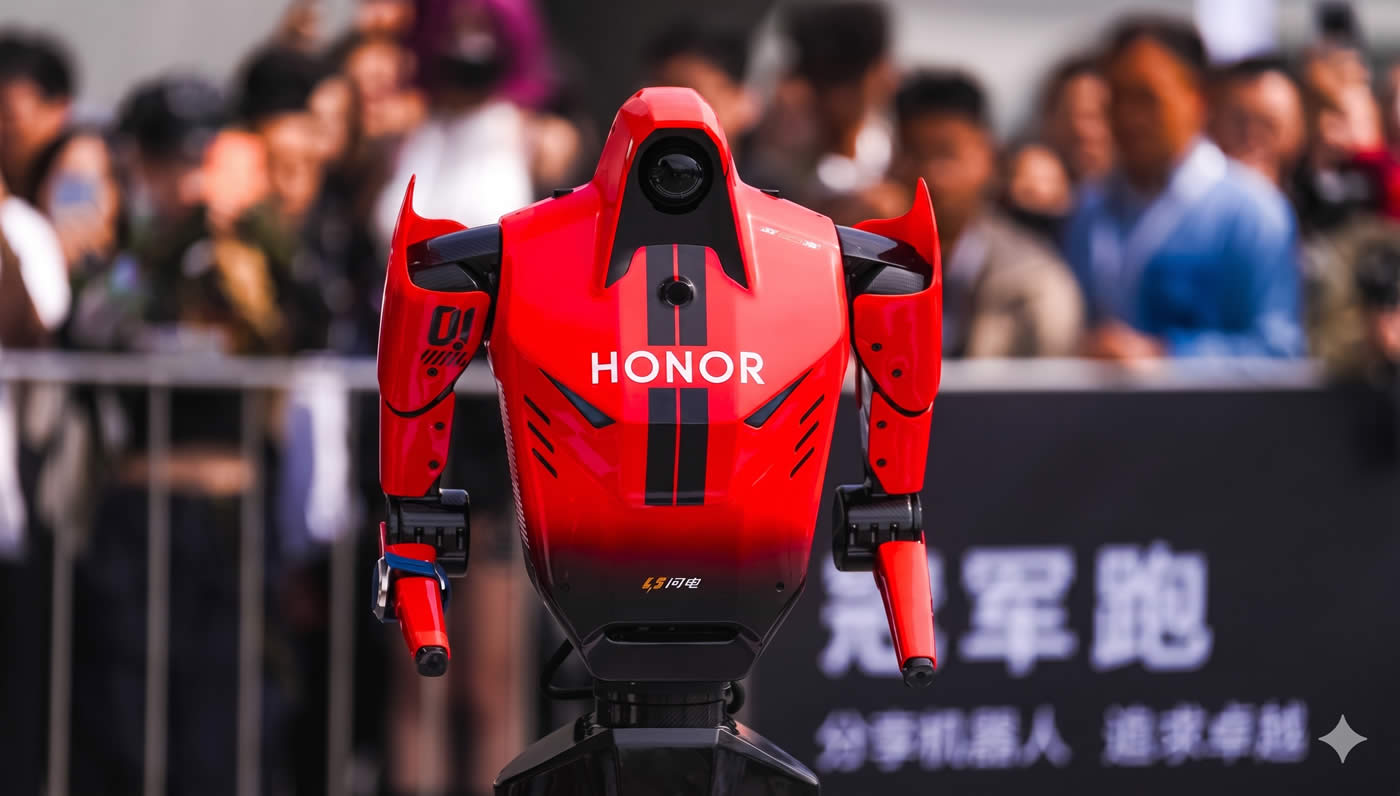
The first is Honor. The consumer-electronics brand didn’t just win the marathon; it won with a robot that stayed cool to the touch after 21 kilometers. “We migrated thermal management techniques from our smartphones and laptops,” an Honor team member told media. “That’s why you could touch the motor after the race and it was still cold.” That line item might sound like a minor engineering detail. It’s not. It signals that the systems-engineering muscle, full-device tuning, and supply-chain orchestration forged in the smartphone wars are now being ported straight into robotics. Honor’s robot, “Lightning,” was a warning: embodied intelligence is becoming a product that can be rebuilt faster by companies with industrial maturity that startups simply don’t have.
The second is AutoNavi. Just before the race, the Alibaba-owned digital mapping giant unveiled “Tutu,” a quadrupedal robot designed to guide visually impaired people in open environments. AutoNavi’s real weapon isn’t hardware; it’s twenty years of spatiotemporal data and large-scale mapping infrastructure. When that data backbone gets embedded into a walking machine, you’re not just seeing another robot dog. You’re watching a navigation-scenario giant spill naturally into embodied intelligence. That kind of capability, grown from an existing system rather than brewed from scratch, is often harder to compete with than a better motor.
The third is JD.com. The e-commerce and logistics behemoth didn’t just sponsor the race and deploy robot “ambulances” and repair engineers along the course. A few days before the starting gun, it launched a full-chain embodied-intelligence data infrastructure, covering collection, storage, annotation, training, evaluation, simulation, and testing — alongside its own data-collection terminals, an embodied foundation model, and a data trading platform. The headline-friendly story is “buy a robot on JD.com.” The strategically terrifying one is that JD is sinking its logistics, supply-chain, real-scene access, and data-organizing prowess deep into the robotics stack.
Look at these three together and an uncomfortable question surfaces: what exactly is the moat of a native embodied-intelligence startup? Hardware integration looks increasingly replicable. As I heard firsthand from an upstream battery executive: “Once you figure out the supply chain, a lot of hardware capability can be quickly integrated from outside — modules can be bought, solutions can be pieced together.” The real scarcity isn’t assembling a robot; it’s putting one into a real environment first, running it, collecting data, and mining the know-how that only a live loop can produce. Big Tech, and startups that move like Big Tech, are racing to own exactly that loop.
If the Dark Horses Stop Showing Up, the Industry Is in Trouble
Spectators love upsets. For a young industry, they’re a vital sign. The absence of dark horses would mean the absence of new attack vectors — no fresh engineering logic ripping open the established order, no one compressing iteration cycles in a way that resets the board. If only the usual names ever win, the sector’s competitive metabolism is too slow, and the technology is already starting to calcify.
Right now, that’s not the case, and that’s good. Control algorithms, perception stacks, energy management, whole-machine reliability — each link in the chain is still being redefined. The dark horse isn’t a bug in this race; it’s proof that the race is still alive.
The Clock Is Ticking for Homegrown Players
Here’s why the Yizhuang marathon feels like a turning point. Until now, native robotics companies could lean on a generous narrative: the field is early, the tech is immature, we’re still figuring out the hard engineering details, give us time. Investors and the public largely agreed. There was permission to be slow.
Honor’s victory — sudden, almost unannounced — vaporized that comfort. A consumer-electronics giant with zero obligation to wait for the industry to mature simply compressed a years-long learning curve into a race cycle, using organizational density and supply-chain excellence that most embodied-intelligence startups lack. The “cool motor after 21km” detail is a stand-in for something bigger: systems engineering isn’t just a support act; in extreme, sustained-load scenarios, it becomes the main event. Reliability, thermal management, endurance — they stop being footnote topics and become competitive kill switches.
The new reality for China’s native firms is stark. They can no longer “survive until the industry ripens” and hope to inherit the market. When Big Tech can copy, verify, and enter the field at speed, waiting is a losing strategy. Capital still believes in visions, but it now wants to see a path. Audiences still grant time, but their patience will be reshaped by more polished, reliable products. The race taught the industry a brutal lesson: future competition isn’t about who has the most compelling story. It’s about who has an actual defensible edge that won’t be crushed when a giant steps onto the track.
Races as the Industry’s Measuring Stick — and Mirror
The Yizhuang half-marathon has outgrown the role of a spectacle. Two editions in, with participant numbers swelling from twenty-odd to over a hundred teams, it’s now a self-reinforcing engine: the bigger the race, the stronger the signal; the stronger the signal, the more players it attracts. This year, the format went further, separating autonomous navigation and remote-controlled running into different categories with distinct weighting. The message was clear: finishing matters, but finishing autonomously matters more. The rules are quietly writing the industry’s next technical syllabus — why not all-autonomous battery swaps next year, or dynamic path decisions under minimal human intervention?
Beyond the track, the event is pulling the supply chain into a public dress rehearsal. JD.com ran the support system. Component makers like Inspire Robots, Link Touch, and Hesai rallied publicly around competing teams. The race is no longer just robot vs. robot; it’s the entire supply chain performing on the same stage.
Its deepest value, though, is as the industry’s first unified yardstick. For too long, Chinese embodied-intelligence companies talked past each other: “We’re faster.” “We’re more stable.” “We’re more autonomous.” Without an open, common measure, those claims floated in a fog of self-certification. The marathon drags everyone into the same coordinate system. It can’t measure everything a robot can do, but it measures a set of brutally hard things: stability, systemic integration, autonomy, and whole-machine completion. In an early-stage industry, that’s already a revolution.
What ran out onto that course wasn’t just a collection of robots. It was a new order trying to form. The Yizhuang marathon is forcing startups to prove themselves in the open, nudging the supply chain to coalesce around a live event, and giving capital a public venue to separate substance from story. It’s not gentle. But for China’s embodied-intelligence sector, it might be exactly the growing-up moment it needs.
