
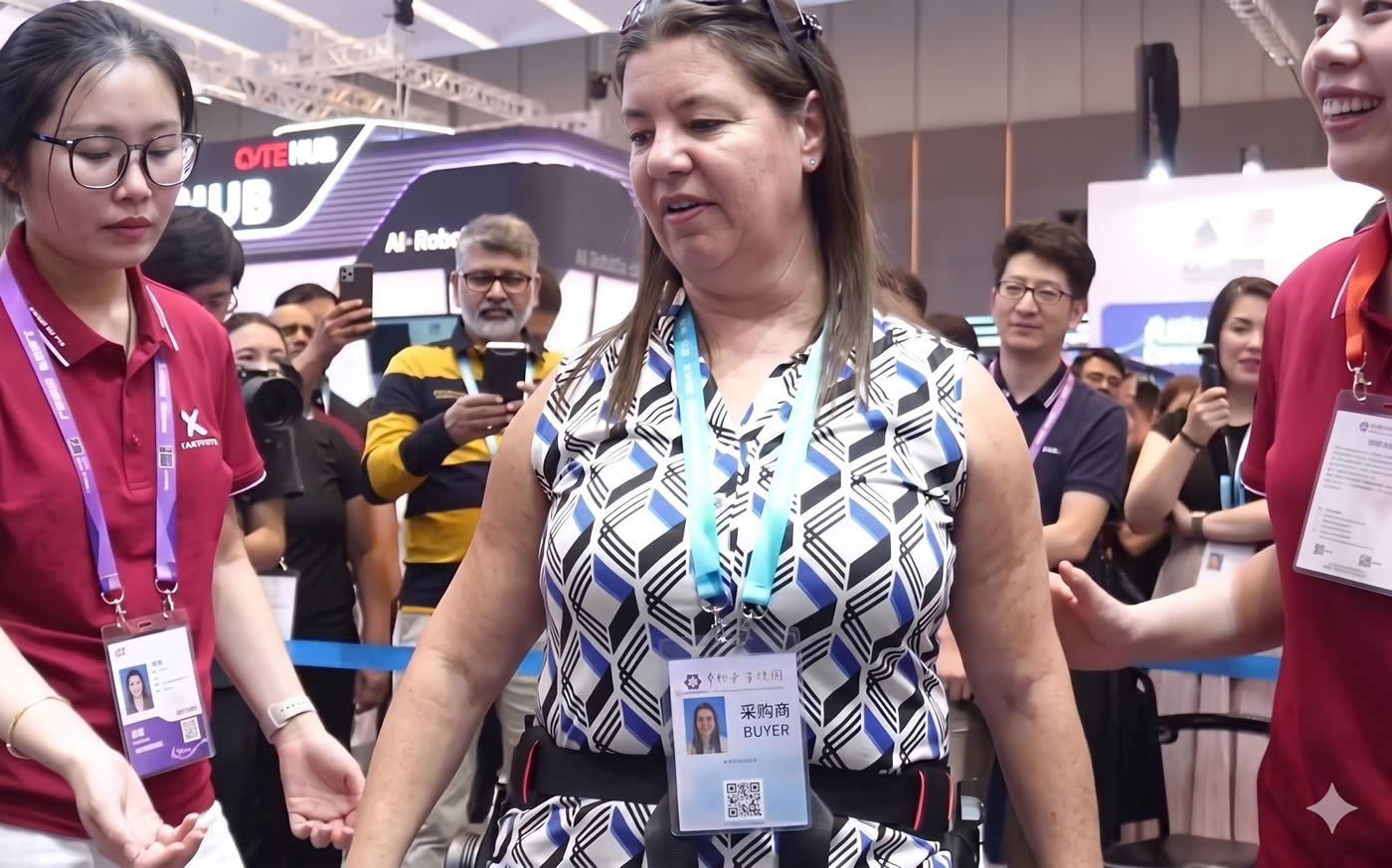
GUANGZHOU, China — At the 139th Canton Fair, a moment of raw emotion upstaged even the most advanced hardware on display. An Argentine woman, long confined to a wheelchair by a muscle-wasting disease, slowly rose to her feet and took her first steps in years — supported by a powered exoskeleton developed by a Chinese startup. Her family wept. The crowd that had gathered around the booth broke into spontaneous applause. Within days, a short video of the scene had ricocheted across social media platforms both inside and outside China, drawing millions of views and an outpouring of empathy. There was no grand narrative, no slick marketing script. Yet that brief, trembling walk conveyed more about the weight and warmth of intelligent manufacturing in China than any polished keynote ever could.
The Moment That Captured the World
What made the moment so stirring was the way it transformed the well-worn slogan “technology changes lives” into a tangible, deeply human miracle. For the Argentine woman, feeling the ground beneath her feet again meant reclaiming a sense of agency and hope that her disease had slowly stolen away. As one online comment simply put it, “This is the power of technology” — a power that restores not just mobility, but a measure of dignity and personhood.
How the Exoskeleton Works
The device at the center of it all is a waist-assist powered exoskeleton, developed by Hangzhou Taixi Intelligent Technology Co., Ltd. It works by using precision sensors to detect even the faintest intention of movement in the wearer’s body, then delivers a tailored burst of motorized assistance — a triumph of artificial intelligence, human-machine interaction and biomechanics. The engineering is impressive, but what the moment really underscored was something broader: China’s growing determination to take frontier technologies out of elite labs and push them toward everyday affordability.
Breaking the Cost Barrier – Made in China, Priced for All
For years, robotic exoskeletons and other high-end rehabilitation devices carried price tags in the hundreds of thousands of dollars, putting them firmly out of reach for the vast majority of people who needed them. Chinese companies are now dismantling that barrier. Armed with homegrown core technologies and the country’s ruthlessly efficient supply chains, they are re-engineering these machines for the real world. The Taixi exoskeleton, for example, uses lightweight carbon-fiber composites and intelligent algorithms capable of millisecond-level responses, yet it is priced at a fraction of what comparable foreign-made systems cost. It reflects an approach that is quickly becoming a hallmark of Chinese innovation: proving not just that something can be built, but that it can be made accessible to the many, not the few.
Policy as a Catalyst for Inclusive Tech
This “tech for good” momentum does not happen in a policy vacuum. Across China, governments are deliberately weaving assistive technologies into social safety nets. In Zhejiang province, for instance, intelligent bionic limbs and similar robotic aids have been folded into official livelihood projects. Through dedicated high-tech disability programs, products such as the smart prosthetics developed by BrainCo — a prominent Chinese brain-computer interface company — have been included in the province’s official catalog of rehabilitation assistive devices. The logic is straightforward: channel cutting-edge tools to the people who need them most, while giving enterprises real-world proving grounds that sharpen their products and anchor their mission.
From Lab to Market: Canton Fair’s New Wave
At this year’s Canton Fair, the results of that ecosystem were on vivid display. From the exoskeleton that helped an Argentine woman stand, to AI-powered interpreting glasses, autonomous patrol robots and self-navigating cleaning machines, a new generation of products is stepping off the expo floor as ready-to-ship, commercially viable hits rather than laboratory curiosities. The packed booths and serious purchase inquiries from international buyers are the market’s own verdict on a distinctly Chinese strain of “inclusive high-tech.”
Beyond Commerce: The Warmth of Chinese Innovation
In that Argentine woman’s tentative footsteps, in her relatives’ tears, and in the excitement rippling through a Guangzhou exhibition hall, there is a story that reaches beyond commerce. It is a story about trust, about technology with a human face, and about a quiet civilizational warmth that can get lost in geopolitical headlines. When Chinese container ships sail for distant ports, they are increasingly carrying something more than competitively priced goods. Nestled inside the shipping manifests is an evolving Eastern conviction — that life-changing innovation should not be a luxury, and that true technological leadership is measured not just by what you build, but by who gets to use it.
